
A bundled launch, minute by minute
No famous name and no headlines: a made-up pump.fun launch built from the patterns researchers keep finding, with every number worked out on the real curve.
Words in this lesson8
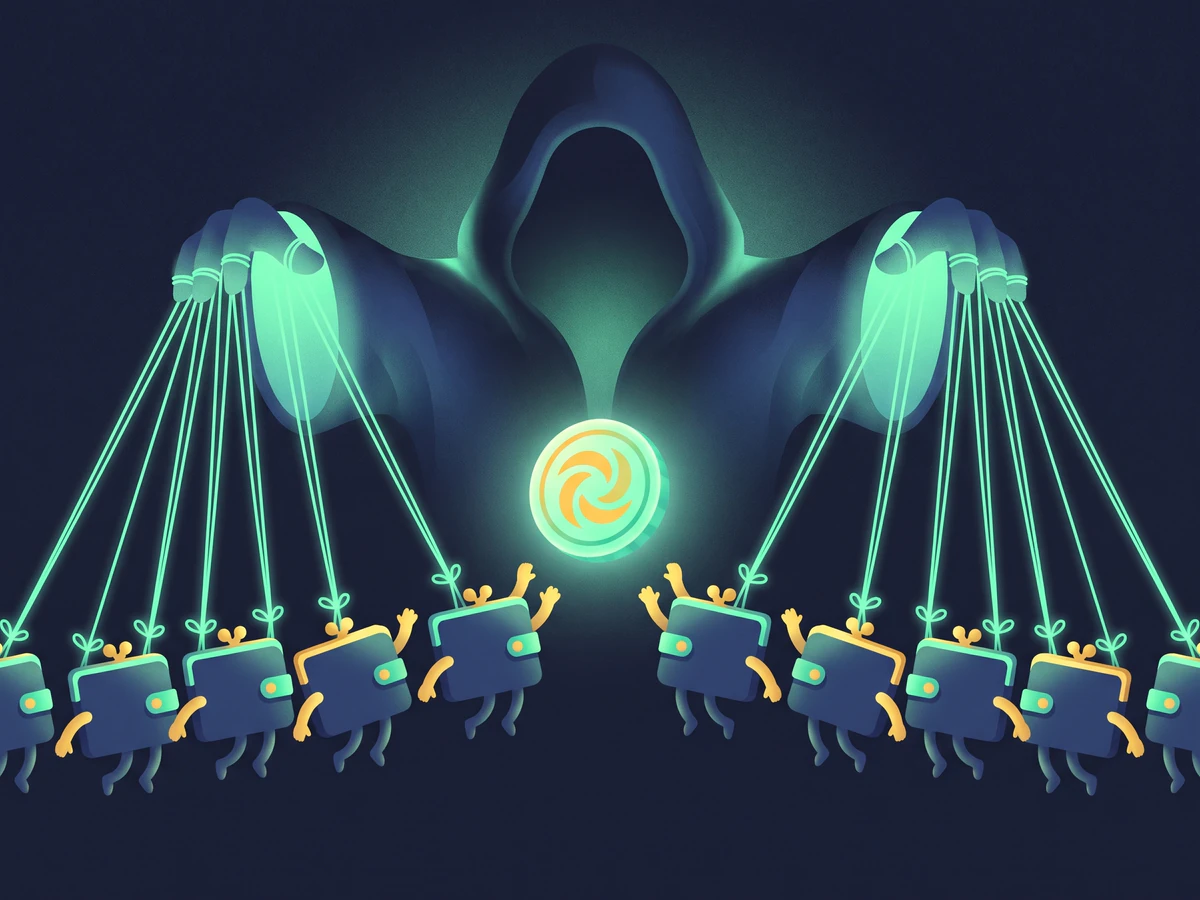
The famous cases make the news. This one does not, because it happens constantly. In about a month in spring 2025, the research group Pine Analytics counted more than 15,000 new pump.fun coins bought in their very first block by wallets the creator had funded. The coin below is made up, and so are its wallets, but every step is a pattern on-chain researchers keep finding, and the numbers use pump.fun's published starting curve.
Before launch
The creator makes ten fresh wallets and sends 2 SOL to each, routed through a couple of extra hops so the link is hard to see. The creator's own wallet will buy nothing. That matters later.
Minute 0: the launch block
One bundle creates the coin and buys it from all ten wallets in the same block, 20 SOL in total. Nobody outside has had a chance to buy. On the curve, those 20 SOL buy about 43% of the supply. Each wallet ends up with between about 3% and 7%, because the price rises a little after every buy.
Minutes 1 to 25: the crowd arrives
Sniper bots buy in the next blocks. A paid post goes up in a call channel. A volume bot trades back and forth to push the coin onto trending lists. Real buyers arrive, see ten holders with 3% to 7% each, and read it as a healthy early crowd. The dev wallet shows 0%, so a quick checker marks 'dev holds nothing' in green.
The case in numbers (made-up coin, pump.fun-style curve, before fees)
Here is what the bundle is worth at minute 25, and what happens when it sells.
- Step 1: Launch block: 20 SOL from ten wallets buys about 429 million tokens. The market cap after the bundle is about 78 SOL.
- Step 2: Minute 25: other buyers have put in about 48 SOL, and the market cap reaches 300 SOL.
- Step 3: On paper the bundle's tokens are worth about 129 SOL at that price. That number is a mirage, because selling them moves the price.
- Step 4: Minute 31: the ten wallets send everything to one new wallet, which sells it all in one transaction for about 56 SOL. That is 20 SOL in and 56 out.
- Step 5: The market cap falls from 300 SOL to about 56 SOL, about 81% in one candle.
- Step 6: Everyone who bought after the launch block put in about 48 SOL. The curve now holds about 13 SOL for all of them. The other 36 or so is the bundle's profit.
What a careful trader would have checked
- Buys in the creation block. Ten wallets buying in the very block the coin was born is a bundle, not a crowd.
- Where the wallets got their SOL. Solscan shows each wallet's funding, and a bubble map joins wallets that share a source.
- The tags. Terminals such as Axiom and GMGN mark bundled wallets, and Bubblemaps has a bundle checker.
- The sum, not the parts. Ten wallets with 3% to 7% each add up to 43% in one person's hands.
- Transfers between holders. Tokens moving from many wallets into one is often the last warning before a sell.
Real cases follow the same script. In October 2024, Bubblemaps found that a Solana coin called Sharpei had about 60% of its supply bought at launch across more than 100 addresses. Those addresses sent their tokens to one wallet, which sold them in a single transaction for about $3.4 million. The project's team blamed fear spread online and said it no longer had the funds to carry on.
The lesson
Most memecoin losses do not come from famous scandals. They come from ordinary launches like this one, repeated every day. The check takes two minutes: open the first block, add up the linked wallets, and ask what happens to the price if they all sell at once.
Go deeper: how bundling worksNext: what the case files have in commonCheck what you learned
0 of 4 answered
Finished reading? Tick it off and your progress is kept in this browser.
This guide is for learning. It is not financial advice. Most memecoins go to zero and most people who trade them lose money. Only ever trade what you can afford to lose.