
Rug pulls: hard, soft and slow
What a rug pull is, the three kinds you will meet, and how each one takes buyers' money.
On this page
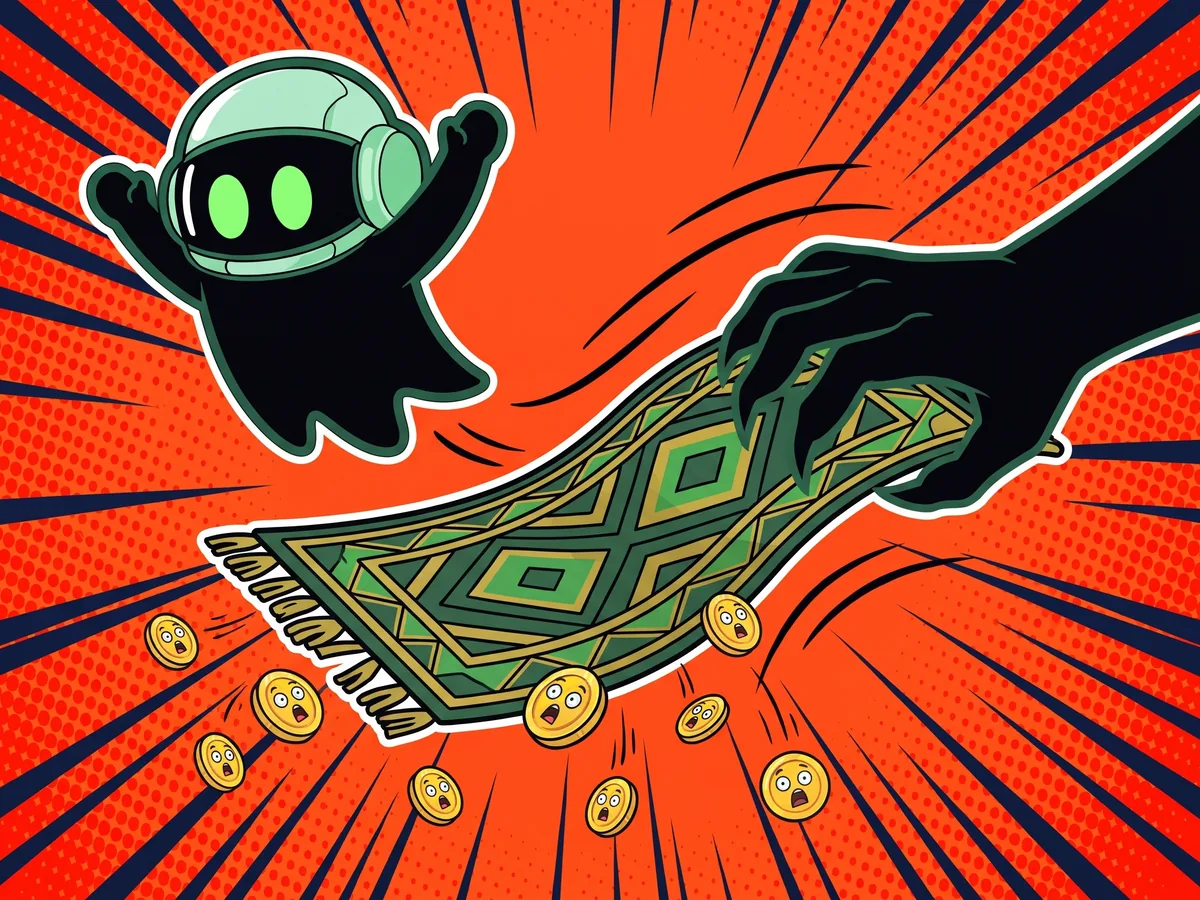
A rug pull is when the people behind a coin take the money buyers put in and leave. The name comes from pulling a rug out from under someone's feet. One moment the chart looks fine. The next, it is a straight red line and the team is gone.
Rugs are one of the most common ways newcomers lose money in memecoins. In May 2025 the blockchain monitoring firm Solidus Labs looked at more than seven million pump.fun coins that traded at least five times between January 2024 and March 2025. It found that 98.6% of them showed signs of a rug pull or a pump-and-dump, with less than $1,000 left in their trading pool. Only about 97,000, roughly 1.4%, were still above that line. Not every dead coin is a scam. But walk in assuming the odds are against you, because they are.
The hard rug
A hard rug is sudden and total. The creator does something that leaves holders unable to get their money out at all. The classic ways are:
- Pulling the liquidity. The creator removes the pool of SOL that every sale is paid from. Your tokens still show in your wallet, but there is nothing left to sell them into.
- Printing new tokens. The creator mints millions of fresh tokens and sells them, so every existing token is worth a sliver of what it was.
- Freezing your account. The creator locks holders' token accounts, so buys work and sells fail. This trap is called a honeypot.
A hard rug needs a switch the creator kept. The next lesson shows how to check those switches in a minute. On pump.fun the launchpad switches them off for every coin, and once a coin graduates nobody can withdraw its pool. That is why hard rugs are rare there and soft ones are not.
The soft rug
A soft rug uses no tricks at all. The creator and their friends hold a large share of the supply and sell it into the people buying. The coin keeps trading. The pool is still there. The price just collapses, and the team stops posting.
Soft rugs are the everyday rug of the trenches, because no launchpad can stop people selling tokens they own.
A soft rug in numbers (made-up coin, simple maths)
A coin has 1 billion tokens and trades at a $300,000 market cap, so one token costs $0.0003. Its pool holds 150 million tokens and $45,000 of SOL. The dev and a handful of linked wallets hold 300 million tokens, 30% of the supply, bought for almost nothing at launch.
- Step 1: On paper their 300 million tokens are worth $90,000 (300 million times $0.0003).
- Step 2: They sell all of it into the pool within a few minutes. Every sale pushes the price down, so they do not get $90,000. With this pool they get about $30,000.
- Step 3: The pool now holds 450 million tokens and only $15,000 of SOL. The market cap drops from $300,000 to about $33,000, a fall of almost 90%.
- Step 4: Everyone who bought near the top is down almost 90%. The $30,000 the insiders took out is the money those buyers put in.
The slow rug
A slow rug is a soft rug stretched over days or weeks. The team keeps posting 'we are building' while their wallets sell a little every day. The chart bleeds instead of crashing, so holders keep hoping. Some teams also collect creator fees from every trade and go quiet once the volume dries up.
Slow rugs are the hardest to spot, because each sale looks normal on its own. The clue is in the wallets, not the posts. If the dev wallet, or wallets it funded, keep shrinking while the team talks about the roadmap, believe the wallets.
Next: the switches a creator can keepCheck what you learned
0 of 4 answered
Finished reading? Tick it off and your progress is kept in this browser.
This guide is for learning. It is not financial advice. Most memecoins go to zero and most people who trade them lose money. Only ever trade what you can afford to lose.